Untangling the Gordian Knot: Alexander's Sword vs. Clever Strategy
The legend of the Gordian Knot is more than just an ancient tale; it's a timeless parable about problem-solving, decisive action, and the nature of leadership. For centuries, historians, philosophers, and strategists have pondered the perplexing challenge presented by this seemingly insurmountable puzzle and the audacious manner in which Alexander the Great purportedly "solved" it. The core question, often posed as
"Wer Löste Den Gordischen Knoten?" (Who solved the Gordian Knot?), delves into whether Alexander employed brute force or ingenious intellect – a debate that continues to resonate in modern discussions about tackling complex issues.
The Legend of the Intricate Knot and a Prophecy of Power
Our story begins in the ancient kingdom of Phrygia, a land rich in myth and prophecy, located in what is now modern-day Turkey. Legend tells of a humble farmer named Gordius, who, accompanied by his trusty ox-cart, arrived in the main square of Phrygia. Unbeknownst to him, an oracle had declared that the kingdom’s next king would arrive in just such a manner. True to the prophecy, Gordius was proclaimed king, rising from obscurity to rule a nation.
In an act of profound gratitude and devotion, King Gordius dedicated his ox-cart to the god Zeus. As part of this offering, he created an extraordinarily intricate knot, attaching the cart's yoke to its pole. This wasn't merely a knot; it was a masterpiece of entanglement, a Gordian Knot so fiendishly complex that its ends were hidden, its loops interwoven with such cunning that it defied all attempts to unravel it. This legendary knot found its home in the temple of Zeus (sometimes referred to as the Jupiter Temple) in the city of Gordium.
But the knot held more than just historical significance; another prophecy was attached to it. An oracle proclaimed that whoever could successfully untie this indissoluble knot would be destined to rule all of Asia. This powerful prediction ensured that the Gordian Knot became not just a local curiosity, but a symbol of an ultimate challenge, a riddle wrapped in rope that promised unparalleled dominion to the one who could conquer it.
Alexander's Bold Encounter: The Sword-Strike Heard 'Round the World
Fast forward to 333 BCE. Alexander, the young and ambitious King of Macedon, was already carving his name into history. Having launched his ambitious campaign against the mighty Persian Empire and securing significant victories in Asia Minor, he arrived in Gordium. The legend of the Gordian Knot and its tantalizing prophecy would undoubtedly have reached his ears. As a conqueror driven by destiny, Alexander could not ignore such a powerful challenge.
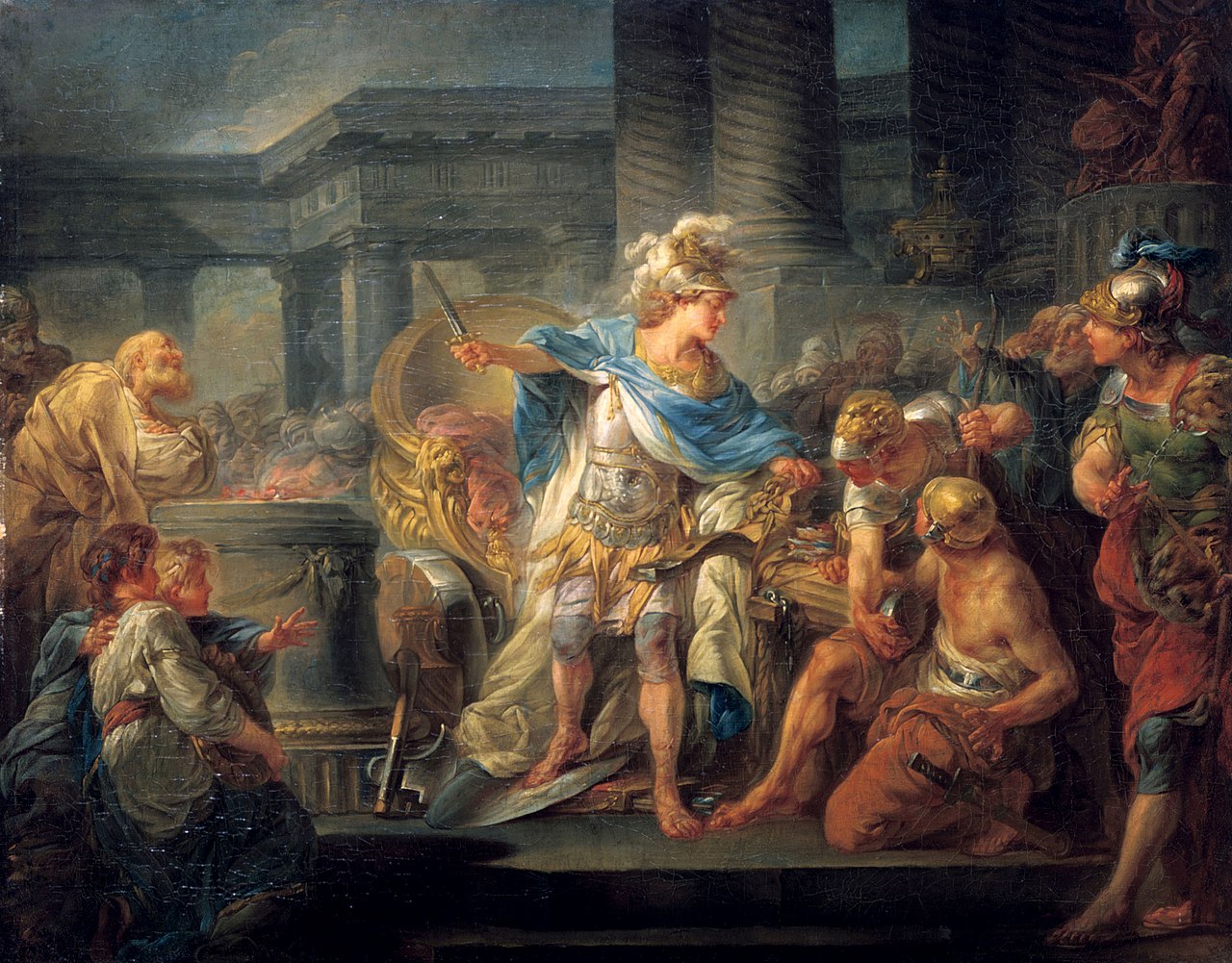
Upon confronting the intricate knot, Alexander found himself face-to-face with a puzzle that had stumped countless others. The traditional method of unravelling seemed impossible, requiring painstaking effort and perhaps a lifetime of dedication. According to the most widely recounted versions of the story, penned by historians like Plutarch and Quintus Curtius Rufus, Alexander displayed his characteristic impatience and decisive brilliance. Instead of laboring over the individual strands, he drew his sword and, with a swift, powerful stroke, simply cut the Gordian Knot in two. "Thus," he declared, "I have loosed it!"
This act was more than just a physical solution; it was a profound symbolic gesture. Alexander didn't play by the established rules; he redefined them. He bypassed the conventional, insurmountable difficulty with an audacious, unconventional, and ultimately effective direct action. This immediate, forceful approach cemented his image as a leader who could overcome any obstacle. And indeed, following this dramatic moment, Alexander's conquest of Asia accelerated dramatically, taking him all the way to the borders of India, seemingly fulfilling the oracle's prophecy and affirming the validity of his radical solution. He truly demonstrated
who solved the Gordian Knot – at least in the most memorable and impactful way.
The Alternative Narrative: A Strategic Mind at Work?
While the image of Alexander cleaving the Gordian Knot with his sword is etched into popular imagination, a compelling alternative tradition offers a different, perhaps more intellectual, interpretation of his actions. This less violent version suggests that Alexander, rather than resorting to brute force, employed cleverness and strategic insight to solve the intractable problem.
This alternative account, notably mentioned by historian Arrian, who himself referenced Alexander's companion Aristobulus of Cassandreia, proposes that Alexander observed the knot more closely. Instead of attempting to unravel the intertwined ropes, he simply removed the "linchpin" or "pole-pin" (often referred to as the *Deichselnagel* in German) that secured the yoke to the cart's pole. Once this central peg was withdrawn, the entire complex arrangement of ropes, no longer held in tension, simply fell apart. The knot was "solved" not by destruction, but by understanding its fundamental vulnerability and removing the element that gave it its structural integrity.
This narrative casts Alexander not merely as a warrior, but as a shrewd tactician, a leader capable of discerning the core issue behind a seemingly overwhelming problem. It suggests that he didn't just break the rules; he understood them well enough to find a loophole, an intelligent workaround. This interpretation emphasizes finding the 'weak link' or the 'key' to a problem, rather than just powering through it. Both versions, however, highlight Alexander's unconventional approach, differentiating him from those who merely accepted the knot's 'unsolvable' status. Regardless of which method truly transpired, the outcome was the same: the knot was overcome, and Alexander's legend grew.
The Enduring Legacy: Solving Modern Gordian Knots
The tale of the Gordian Knot transcends its historical context, becoming a powerful metaphor deeply embedded in our language and thought. Today, when we speak of "cutting the Gordian Knot" or "untying the Gordian Knot," we refer to a decisive, often unconventional, action taken to resolve a complex, seemingly intractable problem. It's about bypassing endless deliberation and intricate troubleshooting in favor of a bold, direct solution.
In contemporary life, we encounter "Gordian Knots" constantly – whether in business, politics, personal relationships, or global challenges. These are the situations where traditional approaches have failed, where incremental solutions only add to the complexity, and where a paradigm shift is desperately needed.
Consider these practical applications of Alexander's legacy:
*
In Business: A company facing crippling bureaucracy might need a leader to "cut the Gordian Knot" by radically restructuring departments or implementing entirely new operational strategies instead of patching existing flaws.
*
In Personal Life: An individual grappling with a long-standing, complicated issue, such as a toxic relationship or a career rut, might need to make a drastic, decisive change rather than attempting to incrementally fix it. This could mean ending a relationship, making a significant career pivot, or moving to a new city.
*
In Innovation: Breakthrough innovations often involve "cutting the Gordian Knot" of existing technological limitations or conventional thinking, finding a completely new path rather than refining old ones.
The key takeaway isn't always about brute force. It's about discerning *when* a problem requires a radical solution and having the courage to implement it. It encourages us to ask: Is this problem truly unsolvable by conventional means, or are we just trapped by conventional thinking? Sometimes, like Alexander, we need to step back, reassess the constraints, and find an entirely new angle – whether it’s a swift "sword-strike" or the strategic removal of a crucial "linchpin." For deeper insights into how this ancient legend continues to shape our understanding of problem-solving, explore
Alexander's Gordian Knot: Sword, Prophecy, and Modern Meaning and
The Gordian Knot Legend: Alexander's Solution to an Impossible Problem.
Ultimately, the legend of the Gordian Knot continues to inspire and challenge us. It reminds us that some problems defy conventional logic and demand extraordinary solutions. Whether Alexander literally wielded his sword or employed a strategic maneuver to unravel the impossible, his actions in Gordium became a powerful testament to the impact of decisive leadership and unconventional thinking. The choice between the sword and clever strategy highlights a fundamental debate that remains relevant for anyone facing an overwhelming challenge: when to be bold, and when to be brilliant. The legacy of the Gordian Knot endures, prompting us to always seek the most effective path forward, even if it means forging our own.