Alexander's Gordian Knot: Sword, Prophecy, and Modern Meaning
The annals of history are replete with tales of legendary figures facing seemingly insurmountable challenges, but few stories resonate with the enduring power and symbolic weight of Alexander the Great and the Gordian Knot. This ancient riddle, tied to a divine prophecy, became a pivotal moment in the young king's meteoric rise, forever stamping his name on a phrase that still describes unconventional problem-solving today. For those who ponder, "
Wer Löste Den Gordischen Knoten?" the answer lies in a legendary act of decisiveness that paved the way for an empire.
The Ancient Legend of the Gordian Knot
Our journey begins in the ancient city of Gordium, located in Phrygia, a region now part of modern-day Turkey. Legend has it that the Phrygians, without a king, consulted an oracle who prophesied that their next monarch would arrive in the city on an ox-cart. Soon after, a humble peasant named Gordius, riding just such a cart, entered the city square. True to the prophecy, he was proclaimed king. In an act of gratitude and piety, King Gordius dedicated his ox-cart to the god Zeus, placing it in the temple.
Attached to this very cart, specifically between the yoke and the pole, was a knot of extraordinary complexity. Crafted from cornel bark, its ends were intricately woven and concealed, making it appear utterly impossible to untangle. This was the infamous Gordian Knot. Another oracle proclaimed that whoever could unravel this marvel of knot-tying would be destined to rule all of Asia. For generations, many tried, all failed, and the knot remained a potent symbol of an insoluble problem, waiting for its fated conqueror. To delve deeper into the origins of this fascinating enigma, explore
The Gordian Knot Legend: Alexander's Solution to an Impossible Problem.
Alexander's Audacious Solution: Sword or Sagacity?
Fast forward to 333 BCE. Alexander, the ambitious young king of Macedon, was on his relentless campaign against the mighty Persian Empire. Having already secured significant victories in Anatolia, his path led him to Gordium. He had undoubtedly heard the whispers of the prophecy and seen the awe-inspiring knot. Here was not just a physical challenge, but a symbolic one – a test of destiny, a direct challenge from the gods themselves.
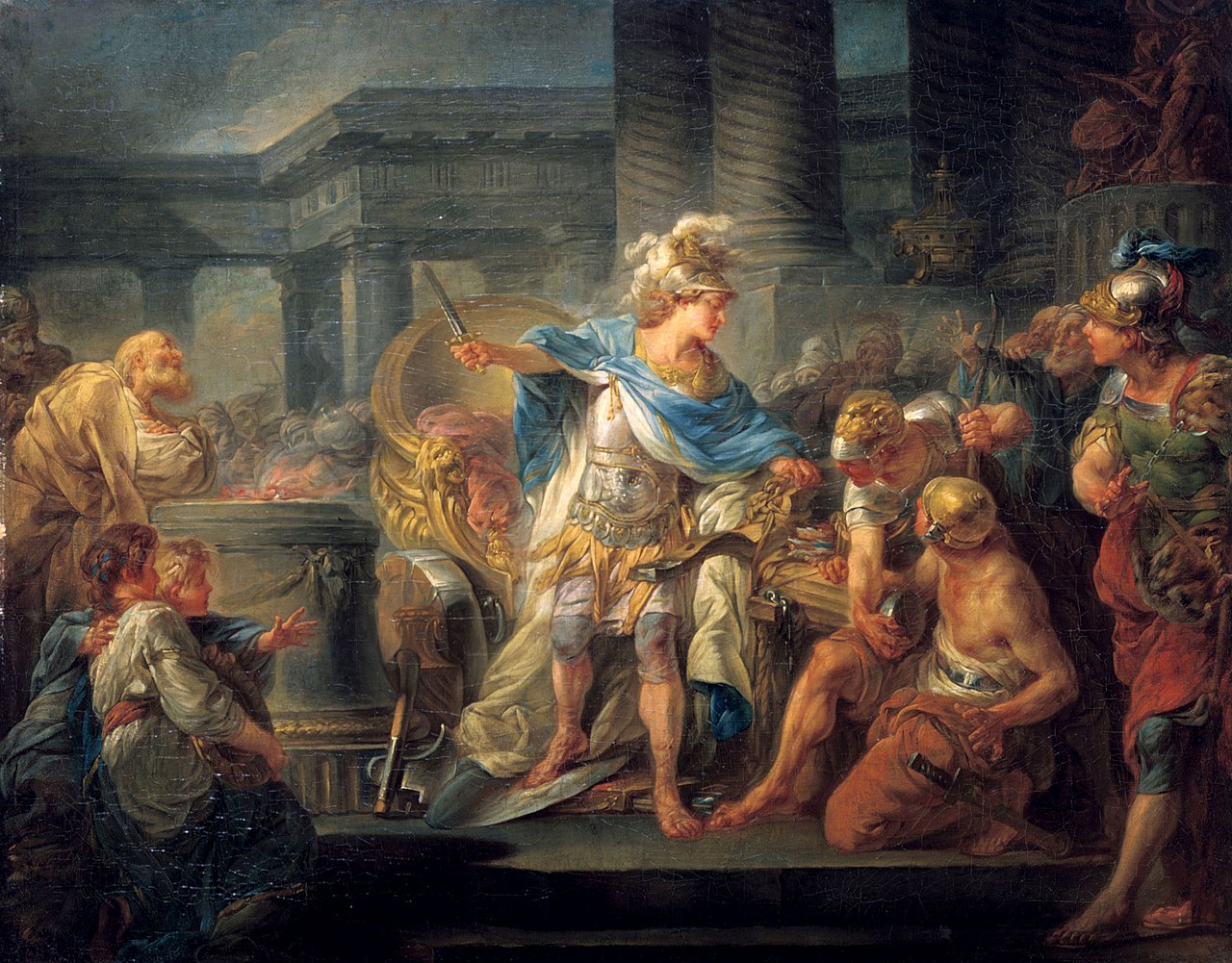
According to the most widely accepted accounts from ancient historians like Plutarch and Quintus Curtius Rufus, Alexander approached the knot, examined its bewildering complexity, and, rather than attempting to meticulously untangle it, drew his sword. With a swift, powerful stroke, he simply sliced through it, declaring, "It makes no difference how they are loosed." In an instant, the seemingly impossible was made possible. This decisive act immediately fulfilled the prophecy, asserting his claim to Asian dominion not through patience or conventional wisdom, but through radical action.
However, an intriguing alternative narrative exists, put forth by historians like Arrian, who referenced Alexander's companion, Aristobulus of Cassandreia. This version suggests a more clever, less violent solution. Instead of cutting the knot, Alexander observed that the knot itself secured the yoke to the pole via a linchpin (or *Deichselnagel* in German). By simply pulling out this pin, the entire assembly loosened, and the knot fell apart. This "intelligent" solution implies that Alexander didn't destroy the problem, but rather found an unconventional way to bypass its apparent constraints.
Regardless of which account one believes, Alexander effectively "solved" the Gordian Knot. His actions, whether through brute force or ingenious circumvention, demonstrated a profound understanding of the situation: that some problems cannot be overcome by conventional means and require a fundamentally different approach. The enduring question "
Wer Löste Den Gordischen Knoten?" is answered with Alexander's name, cementing his reputation as a leader who dared to redefine the rules. For a more detailed comparison of these two solutions, consider reading
Untangling the Gordian Knot: Alexander's Sword vs. Clever Strategy.
From Ancient Greece to Modern Management: The Enduring Legacy
Following his dramatic resolution of the Gordian Knot, Alexander indeed embarked on an unprecedented campaign of conquest that led him across Asia, through Persia, and all the way to the borders of India. His achievements were monumental, establishing one of the largest empires of the ancient world and forever linking his legend with the prophecy he fulfilled.
Today, the phrase "cutting the Gordian Knot" or "solving the Gordian Knot" has transcended its historical origins to become a powerful idiom in many languages, including German ("
den gordischen Knoten durchschlagen" or "
den gordischen Knoten lösen"). It signifies the act of resolving a complex, seemingly intractable problem by a bold, direct, and often unconventional method, rather than through tedious and ineffective traditional approaches.
This isn't just a historical anecdote; it's a timeless lesson applicable to countless modern scenarios:
*
Business Strategy: Faced with a market saturated by competitors, a company might "cut the Gordian Knot" by introducing a disruptive technology or entirely new business model, rather than incrementally improving existing products.
*
Political Impasses: When negotiations are deadlocked by complex interdependencies, a leader might propose a radical, out-of-the-box solution that reshapes the entire discussion.
*
Personal Challenges: An individual struggling with a chronic problem might find that a drastic change in lifestyle or perspective offers a more effective resolution than years of minor adjustments.
Lessons from the Knot: Applying Alexander's Approach
The legacy of Alexander and the Gordian Knot offers profound insights into effective problem-solving:
1.
Reframe the Problem: Sometimes, the difficulty lies not in the problem itself, but in how we perceive it. Alexander didn't accept the premise that the knot *had* to be untangled. He redefined "solving" it. Ask yourself: Is there an unstated assumption limiting my options?
2.
Embrace Unconventional Thinking: The most straightforward path isn't always the most obvious. Alexander's solution was unorthodox for his time, much like innovative solutions are often met with initial skepticism today. Don't be afraid to challenge the status quo.
3.
Decisive Action: Over-analysis can lead to paralysis. While careful consideration is important, there comes a point where decisive action is required to break through an impasse. Alexander's swift move changed the entire dynamic.
4.
Risk and Reward: "Cutting the Gordian Knot" often involves taking a calculated risk. Alexander risked ridicule or failure, but the potential reward was immense. Weigh the potential benefits of a bold move against its drawbacks.
5.
Simplicity in Complexity: The knot was intricate, but its resolution was surprisingly simple. Many complex problems can be resolved by identifying and addressing their fundamental core, stripping away layers of unnecessary complication.
Conclusion
The tale of Alexander and the Gordian Knot is far more than a historical footnote; it's a testament to the power of vision, courage, and unconventional thinking. It teaches us that true leadership often involves the audacity to challenge established norms and find innovative ways to overcome obstacles. Whether facing ancient prophecies or modern dilemmas, the spirit of Alexander's decisive act reminds us that sometimes, the most elegant solution isn't to untangle the mess, but to simply cut through it, forging a new path toward victory. The question "
Wer Löste Den Gordischen Knoten?" therefore echoes not just a historical query, but a call to embrace bold, decisive action in the face of daunting challenges.