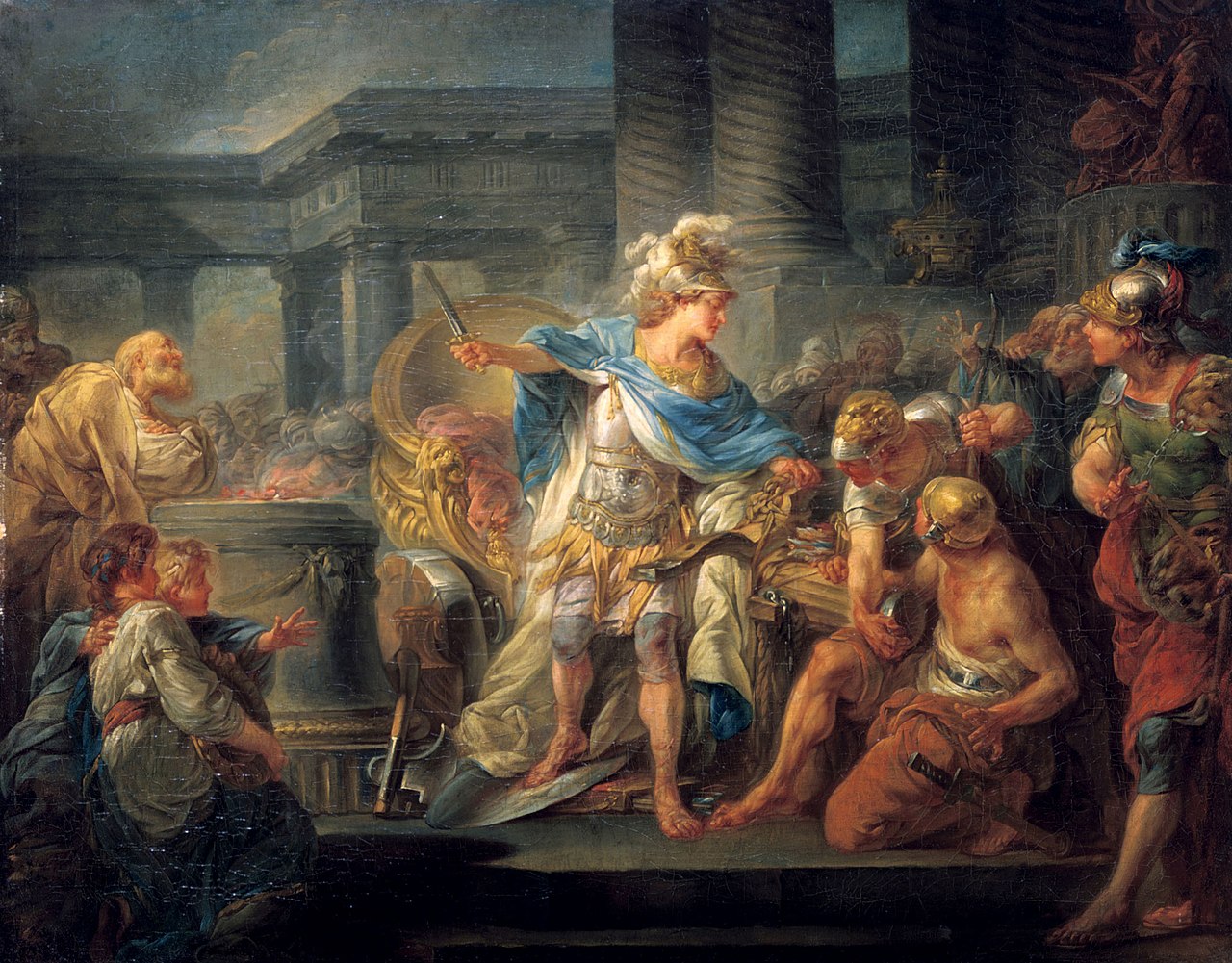
The Gordian Knot Legend: Alexander's Solution to an Impossible Problem
Few historical tales capture the imagination quite like the legend of the Gordian Knot. It’s a story steeped in ancient prophecy, kingly ambition, and a seemingly insurmountable challenge that ultimately became a metaphor for innovative problem-solving. For centuries, people have sought to understand not just the myth, but the profound implications of
Alexander's Gordian Knot: Sword, Prophecy, and Modern Meaning, especially when asking the central question: "Wer Löste Den Gordischen Knoten?" – Who solved the Gordian Knot? The answer, famously, is Alexander the Great, but *how* he solved it has sparked debate and inspired unconventional thinking for millennia.
The Intricate Origin of the Gordian Knot
The story of the Gordian Knot begins long before Alexander stepped onto the stage. According to legend, the Phrygians, an ancient people inhabiting what is now modern-day Turkey, found themselves without a king. An oracle at Telmissus prophesied that their next ruler would be the first person to enter the city gates riding on an ox-cart. Coincidentally, a poor farmer named Gordius (or his son Midas, in some accounts), arrived in the city in precisely such a vehicle. Recognizing the prophecy, the Phrygians immediately proclaimed him their king.
In an act of gratitude and dedication, King Gordius consecrated his ox-cart to the god Zeus. He placed it in the temple of Jupiter (the Roman equivalent of Zeus) in the city of Gordium, Phrygia. Attached to the cart's yoke was a knot of astonishing complexity – a true masterpiece of intertwining cornel bark. It was so intricately tied, so artfully convoluted, that its ends were completely concealed, making it utterly "unentwirrbar" or unsolvable by conventional means. This was the legendary Gordian Knot.
Soon after, another prophecy emerged, elevating the knot's significance to a global scale: "Derjenige, der diesen Knoten lösen kann," or "Whoever could untie this knot," would one day rule all of Asia. This prophecy transformed a local dedication into a test of destiny, laying the groundwork for one of history's most famous confrontations.
Alexander the Great's Confrontation with Destiny
Fast forward to 333 BCE. Alexander III of Macedon, soon to be known as Alexander the Great, was in the midst of his epic campaign against the vast Persian Empire. Having already secured significant victories in Asia Minor and successfully concluded two major sieges, his reputation as a brilliant military strategist was rapidly growing. As he marched through Phrygia, he arrived in the city of Gordium, where he undoubtedly heard tales of the impossible knot and the grand prophecy attached to it.
The challenge presented by the Gordian Knot was not merely a physical puzzle; it was a profound psychological and political test. For Alexander, a man driven by ambition and a belief in his own divine destiny, the prophecy was an irresistible call to action. To bypass the knot would be to deny a powerful omen of his future dominion over Asia. Yet, to attempt to untie it and fail would be a crushing blow to his morale and legitimacy, potentially undermining the very foundation of his claim to Asian rule. The weight of expectation was immense.
He stood before the ancient ox-cart, observing the generations-old enigma. The knot defied all conventional attempts at unraveling. Its intricate design was meant to frustrate, to symbolize a problem that could not be meticulously picked apart. The common approaches, those based on patience and careful manipulation, were clearly inadequate.
The Legendary "Sword Stroke" Solution
The most enduring and widely recounted version of Alexander’s solution is also the most dramatic. As reported by historians such as Plutarch and Quintus Curtius Rufus, Alexander, after pondering the knot, declared that it didn't matter *how* it was untied. With a sudden, decisive motion, he drew his sword and, with a powerful strike, sliced through the knot, effectively "solving" it by destroying it. He "durchschlug ihn kurzerhand mit seinem Schwert" – he cut it through with his sword without further ado.
This audacious act immediately captured the imagination of his contemporaries and posterity alike. It wasn't the expected, patient untying, but a bold, unconventional intervention. Symbolically, Alexander demonstrated that some problems require a radical departure from traditional thinking. He didn't play by the knot's rules; he redefined them. His decisive action sent a clear message: he was not bound by conventional limitations, and he would overcome any obstacle, even one seemingly dictated by fate, through sheer will and unconventional means.
This "solution" was quickly followed by Alexander’s astonishing success, initiating his "gewaltigen Siegeszug durch Asien" (mighty triumphal march through Asia) that eventually led him to the borders of India. To many, his subsequent conquests were undeniable proof that his "sword stroke" was indeed the prophesied act that validated his claim to Asian dominion.
Exploring Alternative Solutions: Cleverness Over Force?
While the sword-stroke narrative is the most popular, another intriguing version of the story exists, suggesting Alexander's brilliance lay not in brute force, but in an equally unconventional form of cleverness. This alternative account, notably preserved by Arrian and attributed to Alexander's companion Aristobulus of Kassandreia, tells a different tale.
In this version, Alexander approaches the knot and, instead of resorting to his blade, recognizes that the knot's complexity was dependent on a central pin. He simply pulled out the "Deichselnagel" or linchpin – the very peg that fastened the yoke to the cart's pole – causing the entire elaborate knot to collapse and fall apart. By removing the linchpin, he effectively disassembled the underlying structure that held the knot together, thus "untying" it without cutting.
This interpretation offers a fascinating counterpoint. It highlights a solution based on insight and understanding the problem's fundamental weakness, rather than pure force. It suggests an intelligent, strategic approach to dismantling a complex system by identifying and removing its critical component. This version asks us to consider if true problem-solving lies in direct confrontation or in understanding the core mechanics that make the problem "impossible." For a deeper dive into these contrasting narratives, see
Untangling the Gordian Knot: Alexander's Sword vs. Clever Strategy.
Both versions, whether violent or clever, share a common thread: Alexander refused to be constrained by the apparent impossibility of the task. He didn't spend endless hours "Tüftelei" (tinkering); he opted for a swift, decisive, and unconventional move.
The Enduring Legacy: "Cutting the Gordian Knot" Today
The legend of the Gordian Knot and Alexander’s solution has transcended its historical context to become a powerful and widely used idiom in modern language. When we speak of "den gordischen Knoten durchschlagen" (cutting the Gordian Knot) or "den gordischen Knoten lösen" (solving the Gordian Knot), we are referring to the act of overcoming a difficult, seemingly intractable problem with bold, energetic, or unconventional means.
This phrase is frequently invoked in various aspects of life, from business and politics to personal challenges:
* **In Business:** A CEO might "cut the Gordian Knot" by completely restructuring a failing department rather than attempting incremental improvements.
* **In Politics:** A diplomat might propose a radical, out-of-the-box solution to a long-standing international dispute that traditional negotiations have failed to resolve.
* **In Personal Life:** Someone might "cut the Gordian Knot" by making a drastic life change – like moving to a new city or changing careers – when conventional attempts to resolve dissatisfaction have yielded no results.
The enduring lesson from Alexander's actions, regardless of which version you prefer, is the importance of thinking differently when confronted with seemingly impossible obstacles.
Practical Tips for "Cutting Your Own Gordian Knots":
- Challenge Assumptions: The first step to an unconventional solution is to question why you believe a problem is "unsolvable" in the first place. What unwritten rules or perceived limitations are you accepting?
- Embrace Bold Action: Sometimes, incremental steps won't work. Be prepared to take decisive, even radical, action if the situation calls for it.
- Seek the "Linchpin": Like Alexander potentially pulling the Deichselnagel, look for the single, critical element that, if removed or altered, will cause the entire complex problem to unravel. What is the fundamental cause, not just the symptom?
- Redefine the Problem: If you can't solve a problem, can you change the problem itself? Alexander didn't untie the knot; he redefined what "solving" it meant.
- Don't Fear the Unconventional: The "best" solution isn't always the most obvious or traditional one. Innovation often arises from thinking outside the box.
Ultimately, the legend of the Gordian Knot continues to serve as a powerful reminder that true leadership and ingenuity often lie in the courage to challenge established norms and find unique pathways through complexity. Whether with a sword or with shrewd insight, Alexander the Great demonstrated that some problems require not just a solution, but a revolution in thinking.